
Transfer pricing documentation is not static. Each year, multinational groups update Local Files, Master Files, financial data, functional analyses, benchmark results, transactions, entities, and conclusions. These changes may be made centrally by the global transfer pricing team or locally by individual entities during the review and approval process.
For many transfer pricing teams, understanding exactly what changed, when it changed, who changed it, and why it matters can be difficult. Traditional document comparison tools may show textual differences, but they do not explain the transfer pricing relevance of those changes.
That is where TPGenie Track Changes adds value.
TPGenie Track Changes is a transfer pricing-specific review and audit trail feature designed to help transfer pricing professionals manage changes in their documentation process. It goes beyond traditional Microsoft Word-style track changes by not only showing textual differences, but also classifying changes based on their relevance within the transfer pricing analysis.
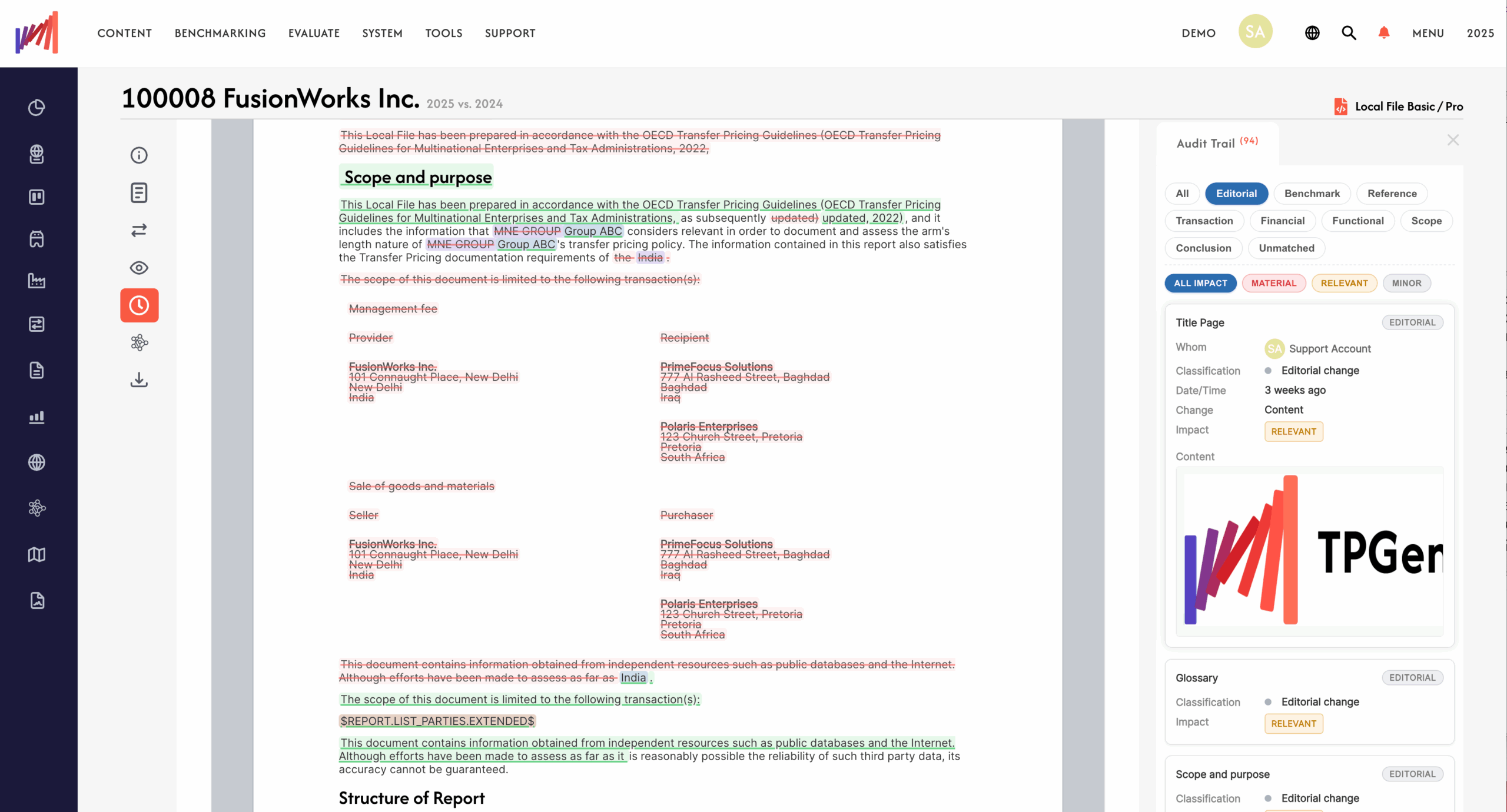
A transfer pricing-specific approach to track changes
In traditional track changes functionality, users can see whether words or paragraphs have been added, removed, or amended. While useful, this does not provide enough context for transfer pricing documentation.
A small wording change in a Local File may be purely editorial. However, a change to the tested party, profit level indicator, benchmark range, functional analysis, risk allocation, or arm’s-length conclusion may have a direct impact on the transfer pricing position.
TPGenie Track Changes is designed specifically for this purpose. It helps users identify not only what changed, but also what type of transfer pricing change occurred and how significant the change may be.
Automated report snapshots within the TPGenie workflow
The Track Changes functionality compares the current version of a report against automatically generated report snapshots within the TPGenie workflow process.
When a new transfer pricing campaign or financial year is initiated and reports are migrated into a new reporting cycle, TPGenie automatically creates an initial report snapshot. This snapshot represents the starting point of the documentation before any new-year changes are made.
TPGenie then compares this initial snapshot against the current version of the report. All differences between the original snapshot and the latest report version are automatically detected and highlighted.
In addition, TPGenie creates an extra snapshot before local users start reviewing financial data and before the workflow review, validation, or approval process begins.
This allows transfer pricing teams to distinguish between:
- changes made centrally by the global transfer pricing team;
- changes introduced locally during the local review process;
- changes made during workflow review and validation rounds;
- changes resulting from updated financial data, benchmarks, or conclusions.
This provides a clear audit trail of how transfer pricing documentation evolved throughout the documentation lifecycle.
Central vs. local changes
In many multinational groups, transfer pricing documentation is prepared through a combination of central and local input. The global tax or transfer pricing team may maintain the core template, transaction descriptions, methodology, benchmarks, and standard wording. Local teams may then review entity-specific facts, financial data, business descriptions, and local filing requirements.
Without a structured audit trail, it can be difficult to determine which changes were made centrally and which were made locally.
TPGenie Track Changes helps reviewers clearly identify:
- which changes originated from headquarters;
- which changes came from the centrally maintained transfer pricing template;
- which changes were introduced locally by individual entities;
- what changed during local review rounds;
- how the report evolved throughout the workflow lifecycle.
This is particularly useful for multinational groups with many Local Files, multiple reviewers, and recurring annual documentation cycles.
Visual redline review inside the TPGenie report preview
The feature is fully embedded within the TPGenie report environment for Local Files and Master Files. Users can review changes directly inside the generated document preview, in the web browser.
Additions are highlighted in green, removals are highlighted in red, and the report is presented in a structured redline format that is familiar to reviewers.
This enables transfer pricing teams to review changes in context, inside the actual documentation environment, rather than relying on separate comparison files or manual version checks.
Transfer pricing change classifications
All detected changes are automatically classified using TPGenie’s transfer pricing-specific classification mechanism.
The system categorises changes into the following transfer pricing classifications:
- Scope
Changes to the scope of the analysis, such as transactions, entities, business activities, or covered intercompany arrangements being added or removed. - Financial
Changes to financial figures or outcomes used in the transfer pricing analysis, including margins, revenues, costs, mark-ups, or profitability results. - Functional
Changes to functions, assets, risks, DEMPE descriptions, or risk allocation. - Method
Changes to the transfer pricing method, tested party, profit level indicator, or the application of the selected method. - Benchmark
Changes to comparable companies, benchmark results, screening criteria, interquartile ranges, or arm’s-length ranges. - Conclusion
Changes to the arm’s-length conclusion, interpretation of results, or final transfer pricing position. - Editorial
Minor textual, formatting, or wording changes without substantive transfer pricing impact.
This classification helps reviewers focus on the changes that matter most from a transfer pricing perspective.
Significance levels for transfer pricing changes
In addition to the transfer pricing classification, each change can receive a significance level.
- Minor
Purely textual, editorial, or cosmetic changes with no substantive transfer pricing impact. - Relevant
Substantive changes with limited impact on the transfer pricing position. - Material
Changes that may affect the functional analysis, method selection, benchmarking outcome, arm’s-length conclusion, or audit defensibility of the transfer pricing documentation.
This helps reviewers quickly prioritise their review. Instead of manually reading every redline change with the same level of attention, reviewers can focus first on material transfer pricing changes.
Impact descriptions for better review and validation
Each change can also include an impact description explaining what exactly changed and why it may matter.
Examples include:
- “Operating margin decreased by 1.4 percentage points”
- “New intercompany service transaction added”
- “Comparable companies updated”
- “Risk allocation wording clarified”
- “Tested party changed from distributor to principal”
- “Arm’s-length range updated after benchmark refresh”
These descriptions make the review process more practical and more transparent. Reviewers do not only see that a paragraph changed; they can understand the underlying transfer pricing impact of the change.
Supporting transfer pricing review and approval workflows
Transfer pricing documentation often requires several rounds of review, validation, and approval. This may involve central tax teams, local finance teams, regional reviewers, external advisors, and final approvers. TPGenie Track Changes supports this process by making changes more visible and easier to assess via the Local File Survey.
Reviewers can quickly understand:
- what changed;
- who made the change;
- when the change was made;
- whether the change was introduced centrally or locally;
- why the change matters;
- whether the change may affect the transfer pricing position.
This reduces the risk that material changes are overlooked during the review process.
Year-on-year transfer pricing documentation review
The Track Changes functionality can also support year-on-year transfer pricing documentation review.
When a new financial year is started, transfer pricing teams often need to assess whether the documentation still reflects the current facts and circumstances. This includes reviewing changes in transactions, business activities, financial results, functions, risks, benchmarks, and conclusions.
By comparing report snapshots across reporting cycles, TPGenie helps transfer pricing professionals review and validate their templates before going live each year.
This makes the annual documentation process more controlled, more transparent, and easier to defend.
A stronger transfer pricing audit trail
Tax authorities increasingly expect transfer pricing documentation to be consistent, well-supported, and aligned with the underlying facts, financial data, and intercompany arrangements.
In the event of a tax audit, it may be important to demonstrate how transfer pricing documentation evolved, which changes were made, and why those changes were made.
TPGenie Track Changes provides a structured audit trail that helps transfer pricing teams answer these questions. It shows how Local Files and Master Files developed during the preparation, review, validation, and approval process.
This can strengthen audit defensibility by giving transfer pricing teams a clearer record of the documentation lifecycle.
Why transfer pricing teams need more than standard track changes
Standard track changes functionality is useful for general document editing. However, transfer pricing documentation requires more than a textual comparison.
Transfer pricing teams need to understand whether a change affects:
- the scope of the analysis;
- the financial results;
- the functional analysis;
- the transfer pricing method;
- the tested party;
- the benchmark;
- the arm’s-length range;
- the final conclusion;
- the audit trail and defensibility of the file.
TPGenie Track Changes is designed around these transfer pricing-specific needs.
Conclusion
TPGenie Track Changes helps transfer pricing teams manage documentation changes in a structured, transparent, and audit-ready way.
By combining visual redline review, automated report snapshots, transfer pricing-specific classifications, significance levels, impact descriptions, and workflow integration, the feature provides more than traditional document comparison.
It helps transfer pricing professionals understand what changed, why it matters, and how those changes affect the overall transfer pricing documentation process.
For multinational groups preparing Local Files and Master Files across multiple countries, TPGenie Track Changes provides a practical audit trail that supports efficient review, better governance, and stronger audit defensibility.
Contact Us for More Info
Recent Comments