
We are pleased to introduce the new TP Forms Module, a new feature designed to help multinational tax teams prepare, review, validate, and generate country-specific transfer pricing forms directly from the data already available in TPGenie.
Across many jurisdictions, transfer pricing compliance is becoming more structured and more data-driven. Tax authorities increasingly require companies to submit transfer pricing information in specific local forms, templates, schemas, or electronic filing formats. These requirements often overlap with information already included in the Local File, Master File, CbCR report, financial data, transaction data, benchmarking analyses, and legal entity data.
In practice, however, TP forms are often prepared outside the central transfer pricing system. Local entities or local advisors prepare the required forms separately, using their own files, templates, interpretations, and manual processes. This creates a real risk of mismatches between centrally prepared transfer pricing documentation and locally submitted forms.
These mismatches can be more than administrative issues. They may trigger questions from tax authorities, create inconsistencies in audit files, increase the risk of local penalties, and in some cases contribute to full tax audits.
The TP Forms Module was built to solve this problem.
With TP Forms, TPGenie brings documentation, structured data, local form preparation, validation, review, and filing support into one controlled environment.
Vision: transfer pricing is becoming data-driven
We believe that transfer pricing is fundamentally shifting from a narative toward a more data-driven discipline.
Traditional transfer pricing has often been document-led. The Local File, Master File, benchmark report, and supporting appendices were the main outputs. Much of the process was narrative-based, with structured data often sitting in spreadsheets, ERP exports, local templates, or advisor workpapers.
That is changing.
Tax authorities are increasingly moving toward structured submissions, electronic forms, public reporting, Pillar Two data requirements, and automated risk assessment. In this environment, consistency, traceability, structured data, and real-time validation are becoming just as important as the narrative documentation itself.
TPGenie’s vision is to support this shift by evolving into a data-first, AI-powered transfer pricing compliance platform. Instead of documents being the starting point, structured data becomes the foundation. From that single data layer, tax teams can generate Local Files, Master Files, CbCR reports, TP Forms, Public CbCR filings, IC Agreements, and other transfer pricing deliverables.
The TP Forms Module is an important step in this direction. It connects the transfer pricing data already available in TPGenie with the country-specific forms and filing formats increasingly required by tax authorities.
Over time, TPGenie will further integrate with ERP systems and AI driven MCP, continuously capturing, structuring, and validating data across the full transfer pricing lifecycle. AI will operate on top of this data layer to generate documentation, detect inconsistencies, identify anomalies, and support decision-making.
The goal is clear: to help tax teams move from fragmented, document-driven processes to a scalable, data-driven approach to global transfer pricing compliance.
Module description
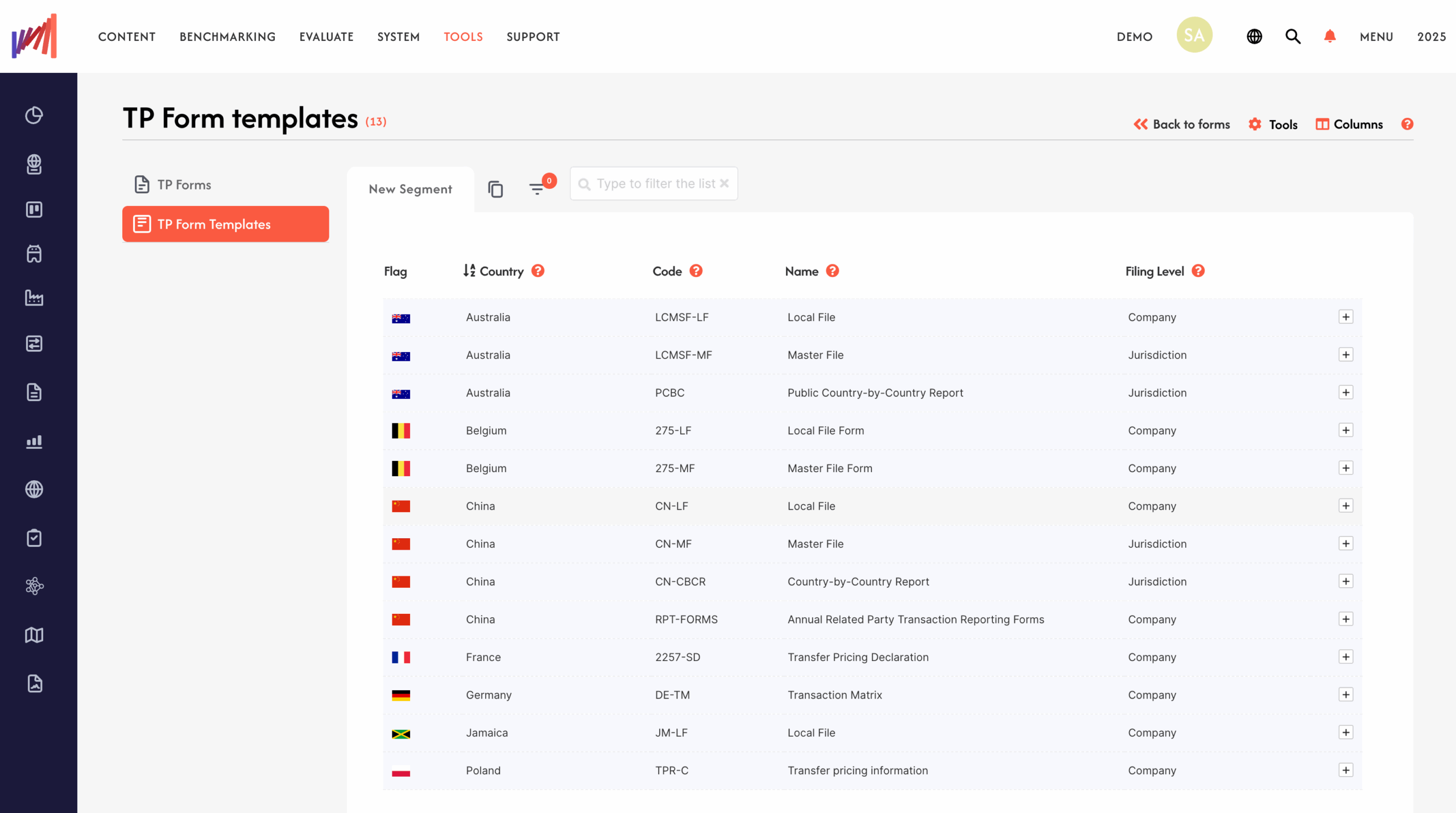
TP Forms is an integrated TPGenie module that automatically generates country-specific transfer pricing forms using data already available in TPGenie.
The module reuses information such as legal entity data, transaction data, financial data, method descriptions, benchmark results, interquartile ranges, CbCR data, Local File content, Master File content, and other relevant transfer pricing inputs. This reduces duplicate data entry and helps ensure that local filings remain aligned with centrally prepared documentation.
Users can create TP forms for specific jurisdictions, enrich the input where needed through an easy-to-use interface, and generate the required output in the format accepted by the relevant tax authority. Depending on the jurisdiction, this may include XML, XBRL, XHTML, PDF, or Excel.
The module also summarises the input data and prepares the country-specific form in both English and the local language, where relevant. This gives users a clear overview of what needs to be reviewed, approved, and ultimately submitted.
Current and planned country coverage includes Poland, Belgium, Australia, Germany, France, China, Jamaica, and Peru. Please reach out to us if you need your jurisdiction’s TP Form to be included.
Technical details
The TP Forms Module is built around dynamic, country- and entity-specific questionnaires. These questionnaires are pre-filled with data already available in TPGenie and can include local business logic, validation rules, threshold checks, and output-specific requirements.
For example, the module can determine whether a filing obligation is triggered based on the relevant transaction type and transaction value. It can also apply jurisdiction-specific logic, such as different thresholds for commodity transactions, financial transactions, services, or other controlled transactions.
Before export, TP Forms performs validation checks. Where applicable, this includes validation against official XSD schemas or other technical specifications required by tax authorities. This helps users detect issues before the form is filed.
The module also includes review and approval workflows, full version storage, and a detailed audit trail. This makes it possible to see what changed, when it changed, and who made the change. For multinational groups, this is particularly important because TP Forms may be prepared by multiple users across different countries, entities, or advisory teams.
TP Forms supports both entity-based and jurisdiction-based filing requirements and can handle multiple entities at once. This allows central tax teams to manage complex filing obligations while still allowing local input where required.
TPGenie is your single source of truth for all your Transfer Pricing deliverables.
Use case: ATO Public CbCR
One of the current relevant key use cases for TP Forms is the Australian ATO Public CbCR requirement.
Many multinational groups are required to file public CbCR information in Australia. At the same time, tooling for this requirement is still limited. In many cases, companies are left with manual XML preparation, separate spreadsheets, or custom local processes.
This creates a familiar risk: the public CbCR data prepared for the ATO may not fully align with the CbCR data, Local File data, entity data, or transaction data already available in the central transfer pricing system.
With TP Forms, TPGenie can use CbCR data already present in the system and prepare the ATO Public CbCR output from that structured data. Users can review the information, enrich or adjust the input where needed, and remain in full control of what is included, excluded, disclosed, or amended before submission.
This is especially important for public reporting. Once data becomes public, consistency and control become even more critical. TP Forms helps tax teams manage this process in a structured, traceable, and reviewable way.
Integration with other TPGenie modules
TP Forms is not a stand-alone form generator. It is designed as an integrated part of the TPGenie platform.
The module connects with our Compliance Tracker, allowing users to monitor country-specific TP form obligations, filing requirements, and statutory deadlines. Filed forms can be recorded in TPGenie, creating a clear overview of filing status across jurisdictions.
TP Forms works also together with TPGenie TP Copilot. TP Copilot can perform AI-based consistency checks and anomaly detection, helping identify mismatches between Local Files, Master Files, financial data, CbCR data, and TP forms before filing.
It also integrates with the Transfer Pricing Calendar, allowing users to receive deadline notifications based on statutory deadlines or internal review timelines. This helps tax teams manage not only the preparation of forms, but also the timing and governance around those filings.
This combination is powerful. The Compliance Tracker identifies what needs to be done. The Calendar helps manage when it needs to be done. TP Forms prepares and validates the actual filing output. TP Copilot helps detect inconsistencies and risks before submission.
Together, these modules support a more controlled, consistent, and data-driven approach to global transfer pricing compliance.
Conclusion
The TP Forms Module is a major step in TPGenie’s development as a data-first and single source of truth transfer pricing compliance platform.
By reusing data already available in TPGenie, applying country-specific logic, supporting review and approval workflows, validating output before export, and integrating with other TPGenie modules, TP Forms helps multinational tax teams reduce manual work and improve consistency across their transfer pricing filings.
As transfer pricing continues to move toward structured data, electronic filings, public reporting, and AI-supported risk assessment, tax teams need more than document generation. They need a controlled data layer that connects documentation, filings, deadlines, validation, and audit transparency.
That is exactly what TPGenie TP Forms is designed to support.
Contact Us for a DEMO
Recent Comments