
TPGenie is the most flexible transfer pricing documentation tool that lets you define the language, structure, and terminology of your local file, and automates everything around it.
We are pleased to announce that TPGenie now supports German-language document templates. This means that users can create transfer pricing documentation directly in German, without relying on a translation layer after the document has been generated.
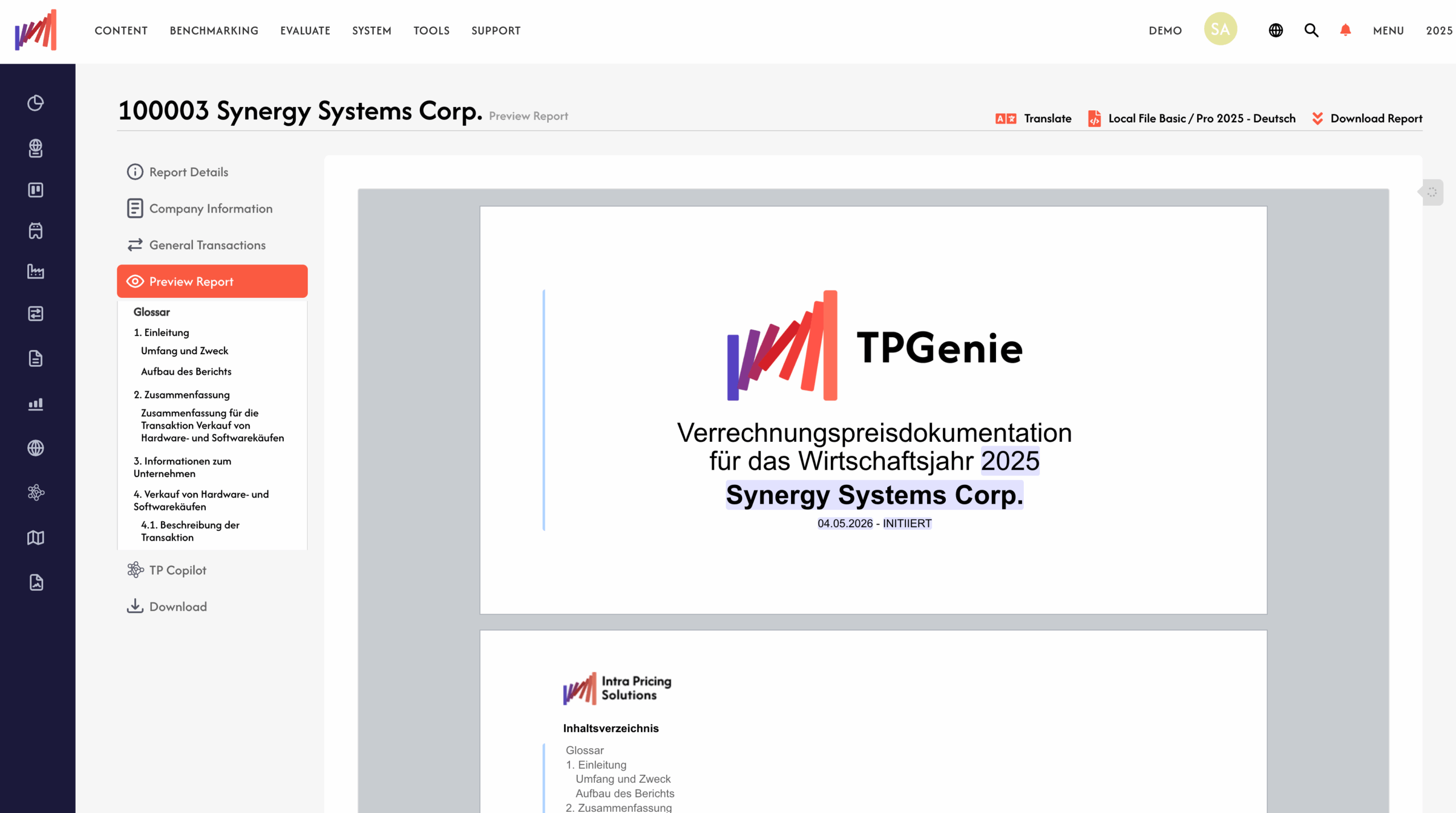
For multinational groups, tax teams, and advisors operating in German-speaking jurisdictions, this is an important step forward. Transfer pricing documentation is not just about translating words. It is about using the right structure, terminology, tables, variables, and country-specific formats in a way that is consistent, defensible, and compliant.
With the addition of German, TPGenie further strengthens its position as a highly flexible and internationally scalable transfer pricing documentation platform.
Native Language Templates, Not Post-Generation Translation
Many tools generate documentation in one default language and then require the output to be translated afterwards. This often creates practical issues. Variables may not match the correct grammar, table headings may remain in the original language, and country-specific terminology can be lost or inconsistently applied.
TPGenie takes a different approach.
In TPGenie, the language is set at the template level. This means that a document template can be designed, maintained, and generated directly in the selected language. The standard template text, headings, explanatory sections, transaction descriptions, and supporting language can all be written originally in that language.
When the document is generated, the automation follows the chosen template language. This includes:
-
Automated tables
-
Variables
-
Standard wording
-
Country names and labels
-
Template-specific logic
The result is a document that is not merely translated, but truly generated in the correct language from the start.
German Language Support for Transfer Pricing Documentation
The addition of German makes it possible to prepare German transfer pricing documentation directly within TPGenie. This is particularly relevant for groups with German entities, German-speaking tax teams, or local advisors who need documentation that aligns with local expectations.
German transfer pricing documentation often requires precise wording, a clear structure, and terminology that reflects both OECD transfer pricing concepts and local German requirements. By enabling German as a native template language, TPGenie allows users to create documentation that is better aligned with these requirements from the beginning.
This reduces manual work, improves consistency, and helps avoid the errors that can occur when documents are translated at a later stage.
Automation That Adapts to the Selected Language
One of the key strengths of TPGenie is that document templates are not static Word files. They are automated templates that can include variables, tables, conditions, financial data, transaction data, and structured content.
With multilingual template support, this automation automatically adapts to the selected language of the template.
For example, when a German template is used, the automated elements in the document can also appear in German. This includes labels, table headings, transaction matrix outputs, financial references, and other automated content.
This makes the documentation process more efficient and significantly more reliable. Users do not need to manually adjust every table, variable, or generated section after the document has been produced.
German Transaction Matrix Included
In addition to German-language template support, TPGenie will also include the German transaction matrix.
This is an important feature because transfer pricing documentation is not only language-specific, but also country-specific. Different jurisdictions may have different expectations regarding the structure, content, and presentation of transfer pricing information.
By including the German transaction matrix, TPGenie allows users to generate documentation that follows the format and requirements relevant for Germany. This helps ensure that the template is not only written in German, but also aligned with the German transfer pricing documentation framework.
Country-Specific and Language-Specific Templates
The combination of language-specific templates and country-specific formats is what makes TPGenie particularly powerful.
Users can create templates that are tailored to a specific country and language. This means that a German template for Germany can differ from an English template for another jurisdiction, not only in wording but also in structure, formatting, and required sections.
This is especially valuable for multinational enterprises that need to prepare local files across many countries. Instead of managing separate manual documents for each jurisdiction, tax teams can use TPGenie to maintain structured templates that reflect local requirements while still using centralised data.
Why This Matters for Multinational Groups and Tax Advisors
For multinational groups, consistency and local compliance are often difficult to balance.
Central tax teams want control, standardisation, and efficiency. Local teams and advisors need flexibility, local language, and country-specific compliance. TPGenie helps bridge that gap.
With German-language templates, users can:
-
Prepare German documentation directly in TPGenie
-
Reduce dependency on manual translation
-
Improve consistency across documents
-
Apply German terminology throughout the document
-
Use automated tables and variables in the correct language
-
Align documentation with German transfer pricing requirements
-
Save time during the local file preparation process
-
Reduce the risk of errors in translated or manually adjusted sections
This creates a more robust and scalable transfer pricing documentation process.
A Unique Position in the Market
The ability to create transfer pricing documentation in multiple languages directly from automated templates makes TPGenie unique in the market.
Rather than treating language as a final translation step, TPGenie integrates language into the documentation engine itself. This means that the template, the automation, and the country-specific structure work together.
For tax teams and advisors, this creates a much more practical solution. Documentation can be prepared in the language required by the local jurisdiction, while still benefiting from automation, structured data, and centralised control.
Built for the Future of Transfer Pricing Documentation
Transfer pricing documentation is becoming more structured, more data-driven, and more closely reviewed by tax authorities. At the same time, multinational groups need to manage documentation across multiple jurisdictions, languages, and local requirements.
TPGenie is built to support this reality.
By adding German-language document templates and the German transaction matrix, TPGenie continues to expand its ability to support high-quality, country-specific transfer pricing documentation at scale.
This update helps tax teams work more efficiently, reduce manual errors, and create documentation that is both consistent and locally compliant.
Conclusion
The addition of German language support is more than a translation feature. It is a native template capability that allows users to create German transfer pricing documentation directly within TPGenie.
With automated tables, variables, conditions, and the German transaction matrix adapting to the selected template language and country format, TPGenie enables a smarter and more compliant way to prepare transfer pricing documentation.
For multinational groups and tax advisors working with German documentation requirements, this is a major step forward.
Contact Us for More Info
Recent Comments